Is There a Belgian Beer that Tastes Like Wine? The Truth
There is something to be said for a beer that tastes like wine and a wine that tastes like a beer. There are some fine lines to be crossed among beer, wine, and cider, and they taste amazing when those lines are crossed.
Belgian beer is often a close cousin of a nice crips wine, so, is there a Belgian beer that tastes like wine?
To have that discussion, we first have to understand the inherent differences between beer and wine.
Wine
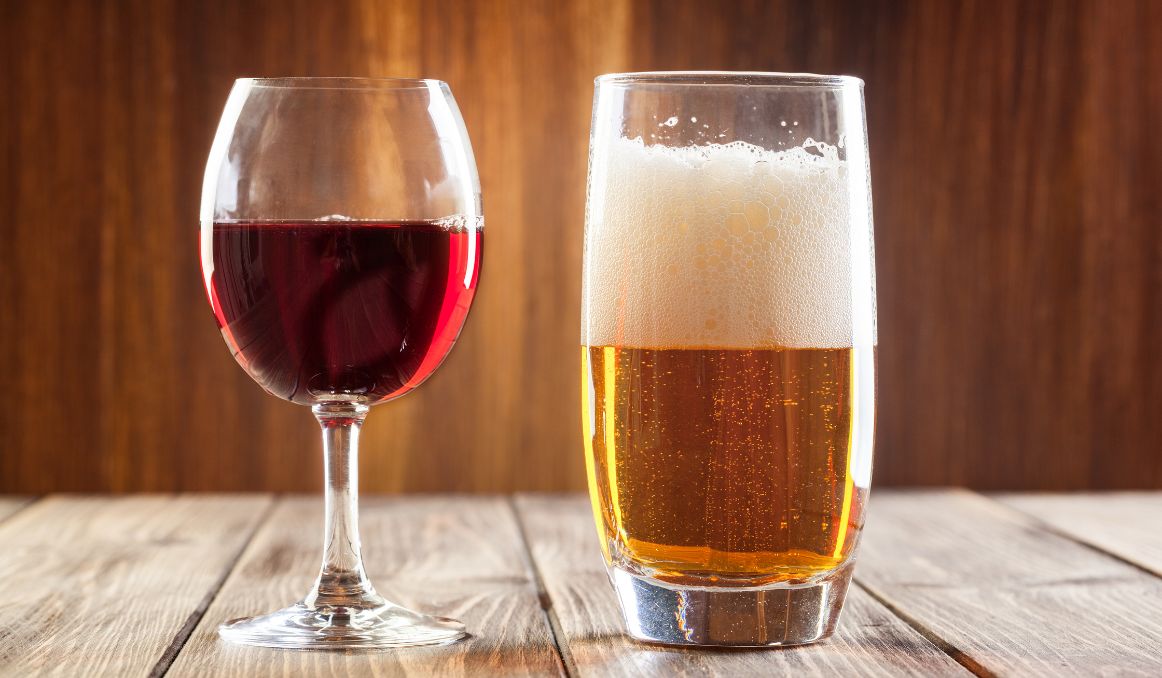
Wine is a simple beverage. It’s basically fermented grape juice.
To make wine, grapes are crushed and allowed to sit in their own juices, getting the skins, stems, and all the good pulp all mixed in and creating a grape juice.
Throughout history then, after a couple of days, the solids were filtered out of the liquid, and now you had what we call “must.”
The must is then allowed to sit in the open air where wild yeast would be attracted to the must.
Why?
Yeast has one job and one job only. Since its inception, billions of years ago, as one of the first forms of life on the planet, yeast, a living organism, has been attracted to sugar. When it gets to the sugar, it consumes all the sugar it can and converts that sugar to alcohol and carbon dioxide.
That’s exactly what happens in wine.
The yeast, whether wild like in the good old days, or commercially produced and added by the vintner, will get to work in the must, converting all those natural sugars from the grapes into alcohol.
Wine is fermented for weeks, with the yeast consuming and converting endlessly until finally it either consumes all the sugar and “flocculates,” settling at the top or bottom of the fermentation tank, depending on the strain of yeast.
The vintner can then collect the yeast and begin to prepare the wine for bottling.
The weeks long process of fermentation in wine is what makes the alcohol content so high.
Beer
Beer is made through a slightly more complex process.
Barley, wheat, and even oat, the grains primarily used to brew beer, do not have naturally occurring sugars in them. They have starch. And it takes a roasting, or “malting” process to convert those starches to sugars in order to induce and encourage fermentation.
Barley, wheat, or oats will be malted to enable that conversion. Then, the grains are cracked or milled in order to expose all the sugars now existent in the grains.
Next, the grains are boiled and steeped in filtered water to release all of those sugars into the water. The liquid is now called “wort.”
At this point, the fermentation process begins, much like with wine, and the yeast will get to work.
With beer, the yeast will finish much more quickly as there is much less naturally occurring sugar to convert to alcohol. So the fermentation process takes days rather than weeks, and the yeast will flocculate at the top or bottom, ready to be skimmed.
As such, the alcohol content in beer is much lower than that of wine, with wine coming in on average at 13% and beer coming in at around 5% on average.
Is there a Belgian Beer that Tastes Like Wine?
So, why would you have a beer that tastes like wine?
Indeed, it makes more sense that you would have a cider that tastes like wine, as cider is made with fruit.
This is where Belgian beer comes into play.
Belgian beer uses a lot of the same techniques as wine.
For witbiers, oranges are introduced to the brew for a fruity flavor, and the beer finishes creamy and tasting a bit like a Chardonnay.
For lambics, or sour Belgian beers, a ton of fruit can be added to the batch, and wild yeast and bacteria are invited to ferment the beer, finishing it off with some tart wine like flavors.
So in the big picture, Belgian beers are typically the most similar in flavor and texture to wine.
But they aren’t the only ones to check out.
Beer for Wine Drinkers
Brewers and vintners alike know they have a cross cultural mix of clients who enjoy both beverages and who love to see combinations of new flavor and aromas cross those fine lines between beer and wine.
For those in that group of beer and wine lovers, the following are some great beers to check out that will have you wondering if you’re not actually sipping fermented grape juice.
Saison
Floral, citrusy, dry, and bright, saison will remind you of champagne.
Belgian Style Tripel
Buttery, oaky, and yeasty, this beer will make you think you’re drinking Chardonnay.
Belgian Dubbel
A fruit salad of a beer, Belgian Dubbel is reminiscent of the soft fruity Pinot noir.
Sterling Hops
Sterling hops are flowery rather than bitter, which will remind you of Pinot Grigio.
Flemish Red Ale
When you taste the notes of plum, red currant, and leather in this red ale, you will instantly think of a nice Cabernet Sauvignon.
Bock
Liquid dessert. If you’re a port lover, you’ll fall for bock.
Double IPA
There are some great grapefruit, lemon, and even tropical fruit flavors in double IPAs that will have you sure you’re drinking Sauvignon Blanc.
Sour Fruit
Tangy, sweet, and fruity, these sour beers are ideal for rose lovers.
So get out there and experiment with the various beers and compare and contrast their similarities and differences from your favorite wines.
It’s all about testing those fine lines and trying new things.
Passionate about the beer and/or wine making process? So are we! If you’re interested in finding out how you can use our technology to control fermentation and monitor your yeast, save work hours and improve the cost-efficiency of your business, drop us a line at [email protected] or check out our product pages:
- Oculyze BB 2.0 (Better Brewing) Yeast Cell Counter App + Hardware
- Oculyze FW (Fermentation Wine) Yeast Cell Counter App + Hardware
Also, you can now get access to a fully functional demo account to test our Web App. Completely free of charge and with no commitment to purchase.
Sources: