How to Measure Bacteria in a Petri Dish
How do petri dishes work?
While we have come a long way in the discovery and work with bacteria, the process of understanding it and measuring it can still be labor intensive. If you’ve been looking for how to measure bacteria in a petri dish, read on for a step-by-step guide.
Download here for free our comprehensive PDF Guide (19 pages) on How to Count Colonies on Agar Plates!
Why Are You Measuring Bacteria?
There are many reasons to study and measure the growth of bacteria, from the study of illness to the study of fermented foods.
When we measure bacteria, we are not typically measuring its size, which is a pretty standard two micrometers, or millionths of a meter long, in rod shapes. Individual bacterium not visible to the human eye as a single cell must be observed either under a microscope or as colonies, which are the product of a single mother cell reproducing asexually over and over until the cells form a mass. A colony is typically defined as at least 50 bacteria cells, which are still not visible to the human eye, and up into the thousands, which is when you will start to see colonies grow.
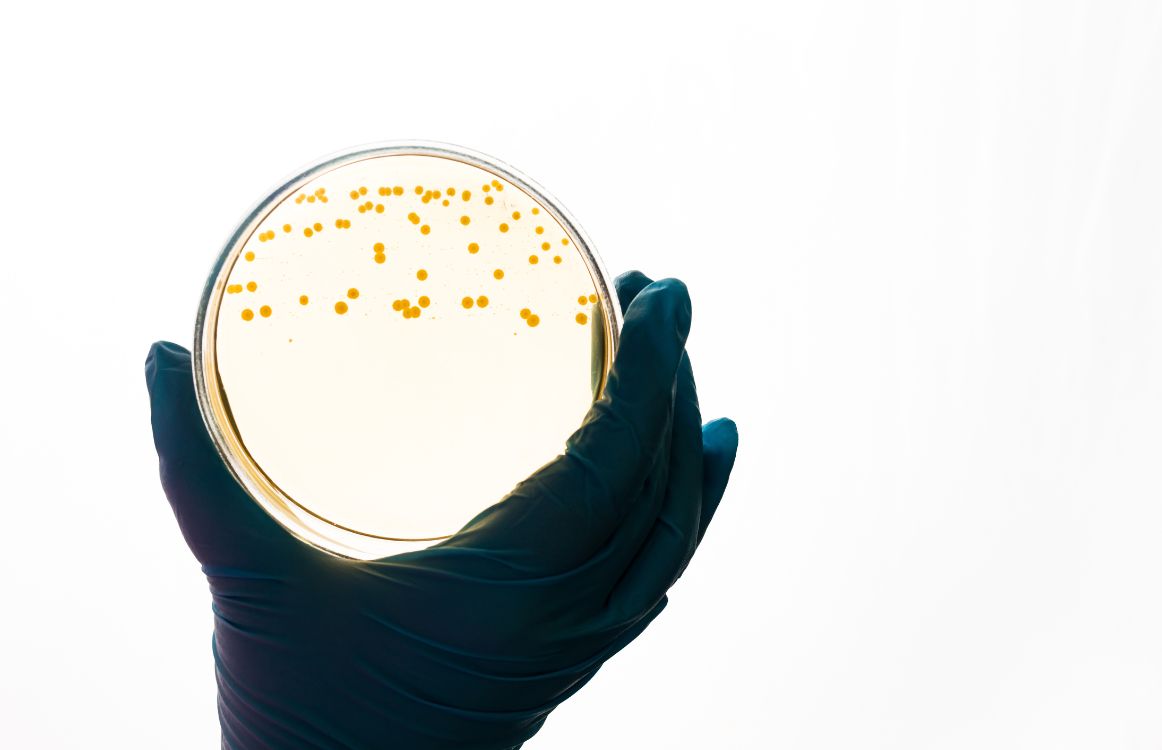
Bacterial Growth in a Petri Dish
Bacteria grow through asexual reproduction, as mentioned above. Under the right circumstances, a single bacterium can feed off starches and sugars, it can get energy from photosynthesis, and it can eat decomposing dead matter and waste. It also forms symbiotic and parasitic relationships with other life forms.
As it feeds, bacteria will reproduce from a single mother cell potentially thousands of daughter cells that are exact genetic matches. Those daughter cells then repeat this process.
We can monitor all of this growth in a petri dish, which is designed to allow us to measure and observe colonies of bacteria at work.
How to Measure Bacteria in a Petri Dish
To measure bacteria in a petri dish, you will need only a few tools:
- Agar plates
- Pasteur pipettes
- Vials
- Dilution medium like sterile water
- Sterile gloves
- Incubator
- Ethanol
You don’t typically need a centrifuge or even a bacteria shaker as you can simply agitate the vials by hand.
Note also that you’re not actually using just a petri dish, which is an empty container with a lid. What you’ll be using instead is an agar plate, which is a petri dish coated with agar that comes with a lid in order to grow and study bacteria.
Agar is a thick gelatin made from red seaweed. It has been used to thicken foods, and it is used in labs to create a growing area.
Thus, to measure bacteria in a petri dish, you want to be sure you have agar plates, not just petri dishes.
To measure bacteria growth, follow these steps.
Sterilize all of your equipment in ethanol to be sure you are only measuring the bacterial culture of your choosing.
Add 10 microliters of your bacterial culture to 90 microliters of your sterile water in a vial. Close the vial tightly and gently shake it to get the addition to combine well.
What you have now is a sample that is one tenth the concentration of the original.
You will need to repeat this process at least five times and up to 10 times more to get a truly diluted solution you can count. As you dilute each sample, be sure you mark the vials as to which dilution it is.
When you are finished diluting, use a pipette to measure out 10 microliters of the last dilution onto one of your agar plates. Repeat this with at least three more agar plates.
Make sure you spread the solution across the entire surface of the agar so you can clearly see the colonies.
Place the lids on the petri dishes and place them in an incubator set to the appropriate temperature for the bacteria you are working with. Allow the bacteria to grow for 16 hours.
After 16 hours, you should be able to see the colonies. Using a marker, mark the bottom of the dish, under the agar plate, where you see a visible colony growing.
To figure out what the total concentration is, you just need to multiply as many times as you divided.
So, if your solution is the 5th dilution from the original, you would multiply the number of colonies you marked by 10 and then by the number of times you diluted, or 5.
For example, if you found 30 colonies, you would calculate as follows:
30 x 10 x 5 = 1500
Thus, you would have 1500 colony forming units, or CFUs, in your starting culture.
You can repeat this process as many times as necessary and watch the bacterial growth over time as well.
Of course, always treat the bacteria you are working with as potentially harmful, although less than one percent of all bacteria does actually cause harm to humans. It is always better to be safe than sorry.
There’s an App for That
Now, the problem with measuring your CFUs manually – marking them with a marker and observing growth with the naked eye or even under a microscope – is human error. There is always room for even the most adept lab technician to make mistakes, miscount, and misunderstand results when identifying bacteria in petri dishes.
To help avoid the element of human error, once you have incubated your bacteria on the agar plate in the petri dish, you can use an app that will count those colonies for you, such as the Oculyze app. Each petri dish comes with its own QR code, so instead of counting your own colonies, you can use the colony counter app to do the heavy lifting for you.
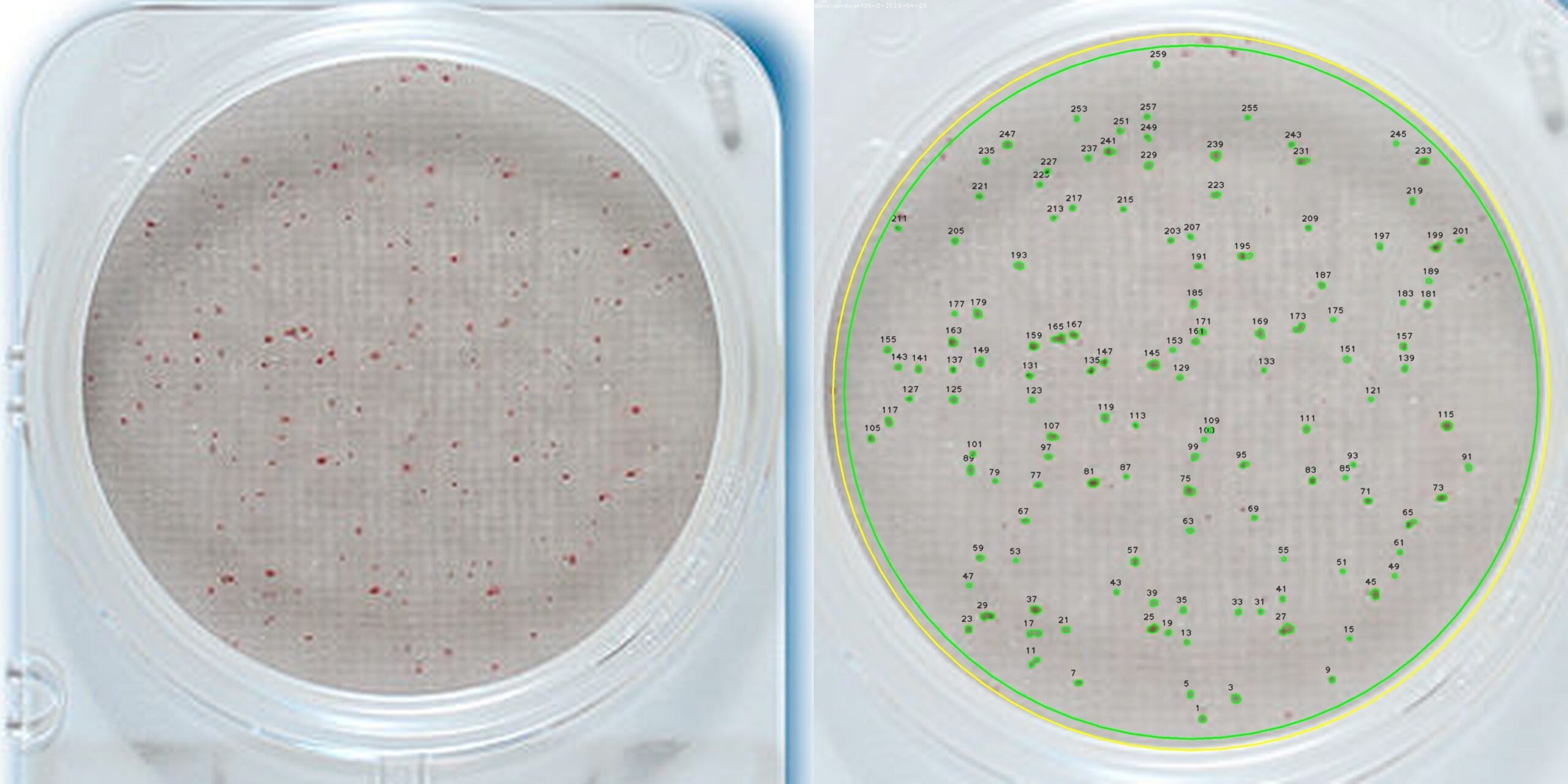
If your agar plates do not come with this type of code, talk to your provider about it. We don’t have to tell you how much time and stress automating your counts could save you.
Artificial intelligence is nowhere more helpful than in the field of biology, where we can get more accurate results in less time, saving money, and potentially lives, in the long run.
Are you an agar plate manufacturer / distributor?
Enhance your product offering by providing your customers with an automated analysis for pre-poured agar plates, which eliminates the need for laborious manual counting! The Automated Counter developed by Oculyze can count colonies with high accuracy and speed, using only an uploaded image of a Petri dish.
Test our Colony Counter! Completely free of charge and with no commitment to purchase. Just please note that the recognition provided here is solely for demonstration purposes and may not accurately represent the performance of our product. Our customers receive customized recognitions tailored to their specific needs, which ensures high levels of accuracy for their plates.
Let artificial intelligence do the hard work for your customers. Want to know more? Contact us and we’ll be happy to help!
Sources: