What Are Colony Forming Units?
Discussing the formation of bacterial colonies on petri dishes
The almost impossibly small size of bacteria made it impossible for us to recognize their existence for millennia. Then we got the technology to view these fascinating life-forms under a microscope. Far from being the terrors we once thought they were, bacteria make tremendous contributions to the health and well-being of humans and life on Earth. Now, we hope to be able to identify and measure their growth in laboratories so that we can learn from bacteria and better understand how to work with them. To that end, we must address the question, “what are colony forming units?”
Download here for free our comprehensive PDF Guide (19 pages) on How to Count Colonies on Agar Plates!
How Bacteria Reproduce
We study colony forming units because bacteria are so microscopic. As they reproduce, however, we can begin to see them better both with a microscope and even with the naked eye. Unlike most living organisms, bacteria reproduce asexually through a process called binary fission. The single cell bacterium will split into two daughter cells identical to each other and to the mother cell. The daughter cells can then reproduce in the same way.
Under a microscope, scientists have discovered bacteria that can divide every 20 minutes, which means that in a matter of hours a single bacterium can be responsible for the production of millions of new bacteria. This growth process is what we study in the lab, a process which can be laborious.

Colony Forming Units
Colony forming units are the masses of bacteria generated from that single mother cells, as far as scientists know. It is thought that each colony we observe is the result of a single mother cell, which is why we find them separated out on an agar plate in a petri dish. We use the term colony forming unit, or CFU, because we cannot be certain if it is truly the result of only a single mother cell generating all those cells or if there are multiple mother cells doing the work together.
Colony forming units is the term used for bacteria, fungi, viruses, and other microbes we study in microbiology to better understand them and their place on the planet and among human life.
We cannot be certain how many bacteria exist in one CFU, though scientists generally agree that it must contain at least 50 individual bacteria. As mentioned above, it can also contain millions.
Colony Forming Units Vs Number of Bacteria
This reality brings us to an understanding of the difference between CFUs and the number of bacteria. It is impractical to think we can count individual bacteria cells as they are not only microscopic but also constantly multiplying. Asking even a highly trained technician to stay on top of this growth is too much.
Thus, we count CFUs, or collections of bacteria, as best we can, still contending with the truth that human error is ever-present.
Colony Forming Unit Protocol
One prevalent form of CFU study is the study of CFU assays, which are in vitro quantitative techniques to discover how exactly that single cell grows into a large colony. We can observe this phenomenon with cancer cells, stem cells, and of course bacteria and viruses.
In these studies, scientists must differentiate between CFUs that continue to replicate and those that fail to do so. From there, we can look into what stops the proliferation. This work is helpful for areas like antibiotics, cancer drug screenings, and even the benefits of probiotic colony forming units, which aid in human gut health which helps humans improve our overall health.
Performing these kinds of observations and studies is labor intensive as we must dilute the culture we are working with so we can properly observe it under a microscope, take care to differentiate, and then draw conclusions based on those observations and calculations.
How to Measure Colony Forming Units
To manually measure colony forming units, you would need:
- Petri dishes with agar plates
- Vials
- Pasteur pipettes
- A dilution medium like sterile water
- Sanitized gloves
- Incubator
You do not need a bacteria shaker as you can simply gently agitate the vials by hand.
To begin, add 10 microliters of your culture to 90 microliters of sterile water in a vial, place the lid on top tightly and gently shake it.
Remove 10 microliters of this dilution to a new vial and add another 90 microliters of sterile water to that.
You have now diluted the original culture twice. You can continue to do this at least another 3 times, and you can do it up to 5 times to get your culture diluted down enough to see your colonies forming.
Be sure to mark each vial with the dilution number.
Now, take your final dilution and, using a Pasteur pipette, spread 10 microliters of the sample across the surface of an agar plate in a petri dish and place the lid on top. Allow it to dry out a bit and then place the petri dish in your incubator at the appropriate temperature for your culture.
After about 16 hours, you will be able to see the CFUs.
Mark the underside of the petri dish, beneath the agar plate, with a dot for each CFU you can see.
Then multiply that number back up to the original colony.
If you diluted the culture 5 times and you ultimately found 35 CFUs, your calculation will look like this:
35 x 10 x 5 = 1,750
You can continue to measure your bacteria growth, or any other culture, in this way.
Colony Counter App
Or, you can utilize an automated colony counter, such as the Oculyze Colony Counter, which allows you to scan the barcode on your petri dish and enter your CFU information. The app will monitor the growth of your culture and give you accurate numbers without the danger of human error. If your agar plates do not come with this type of code, talk to your provider about it. We don’t have to tell you how much time and stress automating your counts could save you.
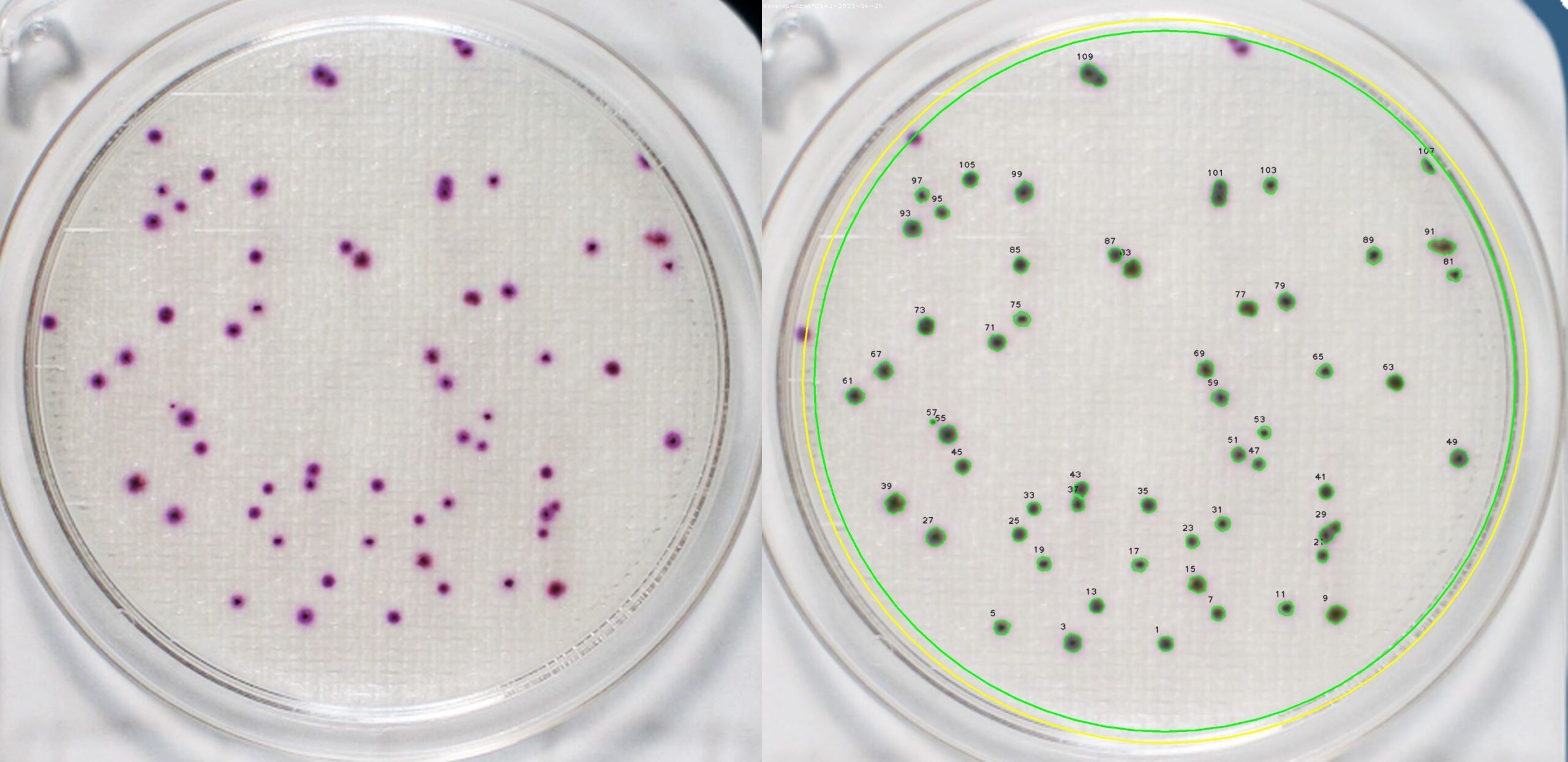
Are you an agar plate manufacturer / distributor? Enhance your product offering by providing your customers with an automated analysis for pre-poured agar plates, which eliminates the need for laborious manual counting! The Automated Counter developed by Oculyze can count colonies with high accuracy and speed, using only an uploaded image of a Petri dish.
Test our Colony Counter! Completely free of charge and with no commitment to purchase. Just please note that the recognition provided here is solely for demonstration purposes and may not accurately represent the performance of our product. Our customers receive customized recognitions tailored to their specific needs, which ensures high levels of accuracy for their plates.
Let artificial intelligence do the hard work for your customers. Want to know more? Contact us and we’ll be happy to help!
Sources: